Self-Sustaining (Funding)
One of the first questions people ask about RISS is simple:
How is all of this funded?
That is a fair question. The answer is that there are really two separate funding questions. The first is how we build the campus. The second is how we operate the campus once it is built. Those are two very different challenges, and they are funded in very different ways.
Building the Campus
RISS will not appear overnight. Like any major infrastructure project, it will be developed in phases. Each phase has a specific purpose and funding goal.
Phase One: Seed Funding
The funding effort currently underway is our Seed Funding Round.
This is not construction funding.
This phase is designed to move RISS from planning and concept development into active organizational development.
The purpose of this funding is to allow the founder to transition from working full-time at an outside position to working full-time on RISS while establishing the organizational foundation necessary to build the project correctly.
Seed funding supports:
Organizational development
Legal and accounting consultation
Office and administrative expenses
Research and planning activities
Partnership development
Community outreach
Business planning and operational development
Other foundational expenses required to move from concept to implementation
In short, this phase creates the foundation necessary to begin building RISS as an organization.
Phase Two: Initial Capital Campaign
Once seed funding objectives have been met, the next major phase is the Initial Capital Campaign.
This phase focuses on preparing the project for construction.
Funding from this campaign will support:
Land acquisition
Architectural design
Engineering services
Site plans and sealed drawings
Permitting
Utility planning and installation
Infrastructure development
Site preparation
This phase transforms the project from an organizational effort into a construction-ready development.
Phase Three: Campus Build-Out Campaign
After planning, engineering, and site preparation have been completed, the project enters the Campus Build-Out Campaign.
This phase focuses on creating the physical campus itself.
Funding will support:
Building construction
Furnishings and equipment
Vehicles and operational assets
Campus infrastructure
Initial staffing costs
Opening expenses
Approximately 24 months of stabilization and operational reserves
This final capital phase is designed not only to build the campus, but to ensure it opens from a position of strength rather than immediately struggling to survive.
Operating the Campus
Once the campus is operational, the question changes.
The question is no longer:
How do you build RISS?
The question becomes:
How do you sustain RISS for the next 10, 20, or 30 years?
That question shaped the design of the project from the very beginning.
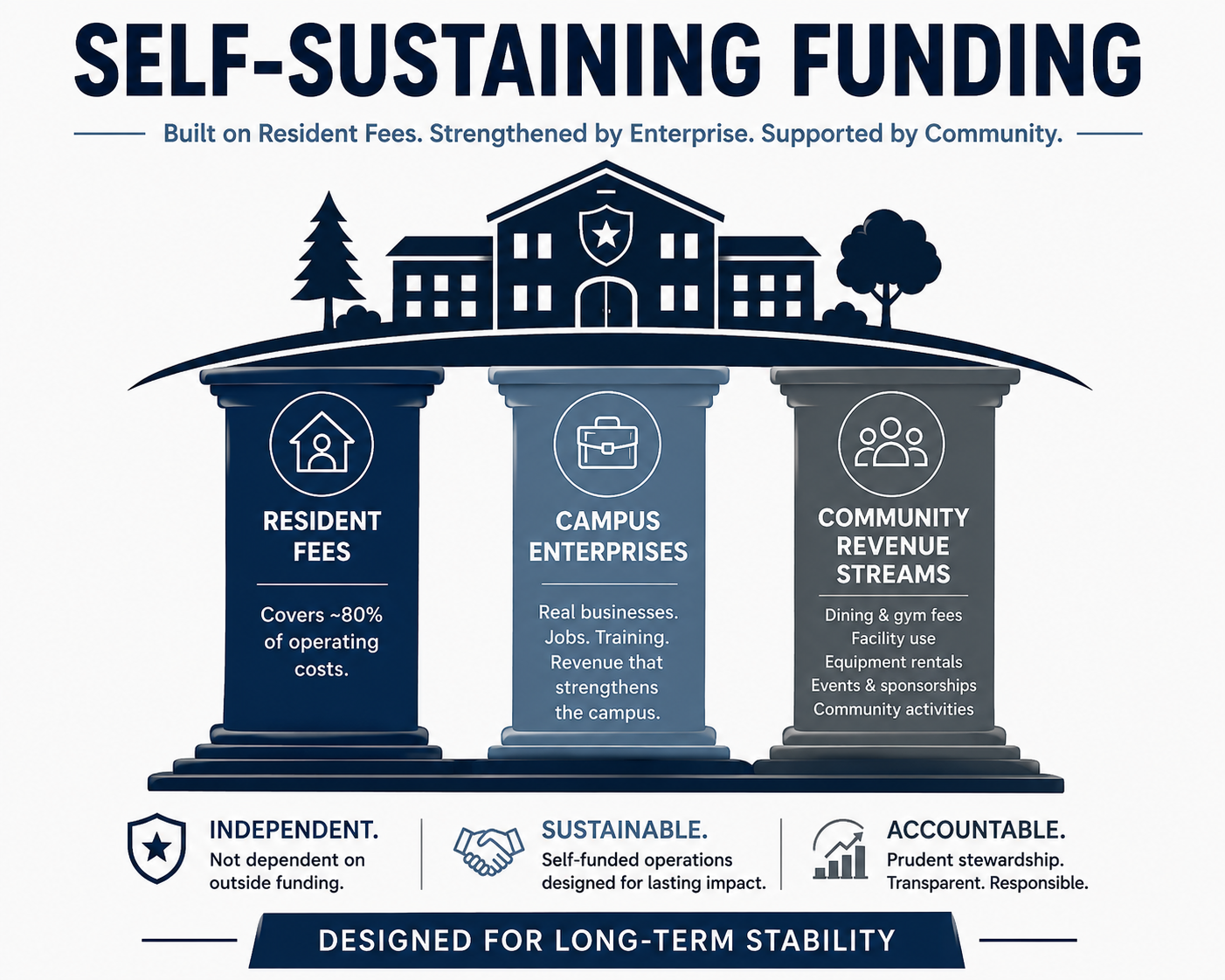
Unlike many organizations that depend on continual grant cycles and fundraising to cover operating expenses, RISS was intentionally designed around long-term self-sustainability.
Resident Fees
The primary operating foundation of RISS is resident fees.
The current projected resident cost is approximately $1,500 per month.
At full occupancy, resident fees are expected to cover roughly 80% of operating costs.
That means the majority of the campus budget is generated by the campus itself rather than relying on outside funding.
This model was not developed in theory.
The first private halfway house I experienced in Texas operated in a similar manner. Resident fees supported housing, meals, laundry services, and other day-to-day necessities. At the time, I assumed that was simply how private halfway houses operated.
Later, I learned that many organizations depend heavily on grants, contracts, and temporary funding sources.
RISS takes a different approach.
Campus Enterprises
The second major operating revenue source comes from campus enterprises.
These are real businesses operating on campus.
Their purpose is threefold:
Create employment opportunities
Provide workforce development opportunities
Generate revenue that strengthens the campus
Unlike traditional businesses, our goal is not maximizing profit for shareholders.
The goal is to operate sustainable enterprises that provide quality jobs, pay competitive wages and benefits, and generate reasonable surplus revenue that can be reinvested into the campus.
Community Revenue Streams
The third revenue layer consists of smaller community-based revenue sources.
Examples include:
Guest dining fees
Volunteer and guest gym-use fees
Facility-use fees for churches and organizations
Equipment rental fees
Community events and tournaments
Sponsorship opportunities
Special campus activities
Individually, these revenue sources are relatively small.
Collectively, they strengthen the overall financial model and reduce reliance on any single revenue source.
Why the "Extras" Matter
Some people look at parts of the campus and see extras.
They see recreation spaces.
They see educational opportunities.
They see community events.
They see wellness facilities.
They see outdoor gathering areas.
They see holiday celebrations.
They see resident enrichment opportunities.
RISS sees something different.
We see stability.
We see community.
We see belonging.
We see opportunities to rebuild confidence, identity, and purpose.
These are not luxury expenses.
They are part of the infrastructure of successful reintegration.
The financial model was designed from the beginning to support these features because they are not secondary to the mission.
They are part of the mission.
Designed for Long-Term Stability
RISS will absolutely continue to welcome donations, sponsorships, grants, partnerships, and community support.
Those resources help expand opportunities, accelerate growth, and support special initiatives.
But the long-term operating model is designed around something different.
It is designed around stability.
The goal is not to build an organization that must continually struggle to survive.
The goal is to build infrastructure that can sustain itself for decades.
Because RISS is not simply a reentry initiative.
It is an investment in long-term community infrastructure.

If you believe reintegration should be built intentionally, not reactively, we invite you to explore how you can help bring the RISS model to life.