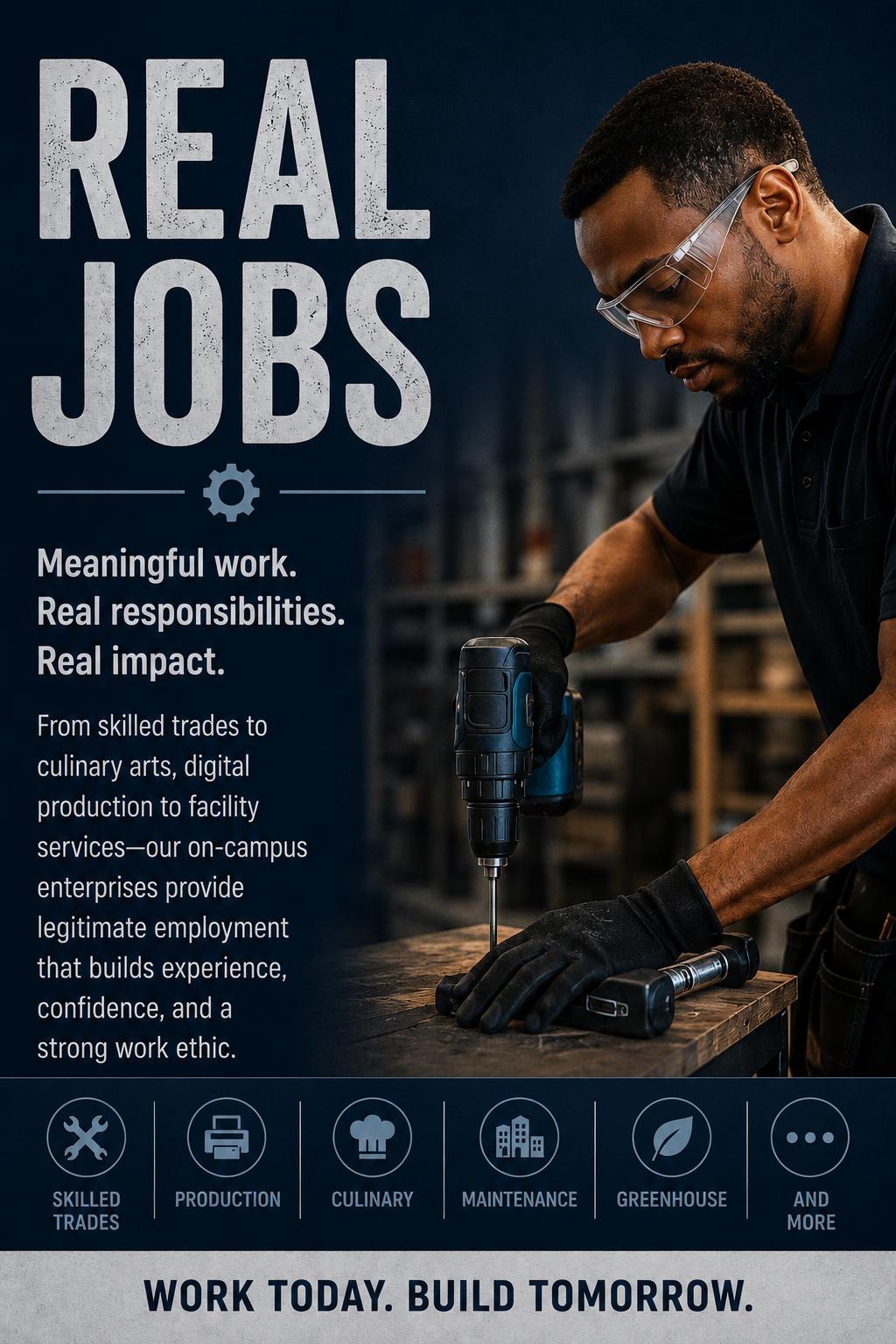
Campus Enterprises
Direct Employment & Campus Enterprises
At RISS, employment is not something residents wait for.
It already exists.
While workforce training builds long-term pathways, direct employment provides immediate access to real work, real income, and real responsibility from the moment a resident arrives on campus. This is not simulated work. It is not “program-based employment.”
These are functioning businesses.
They serve real customers.
They generate real revenue.
And they operate with real expectations.
Immediate Access to Work
One of the most common barriers in reentry is the gap between release and employment.
Applications take time.
Background checks delay hiring.
Opportunities are limited.
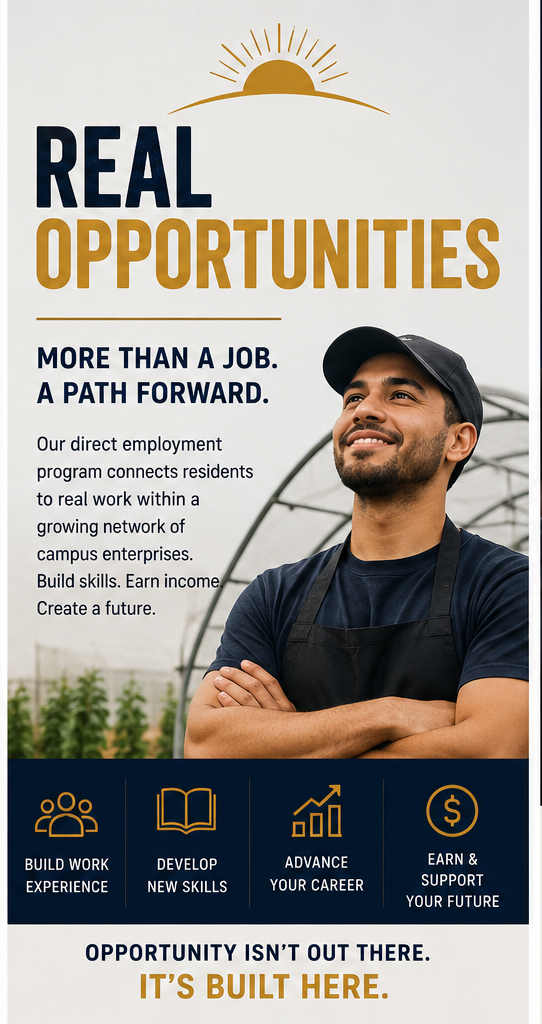
That gap creates instability RISS removes that gap. Residents have the ability to begin working almost immediately through on-campus enterprises, allowing them to:
Earn income right away
Establish work history
Build daily structure and routine
Develop professional habits in a real environment
Real Businesses — Not Program Jobs
There is a critical difference between activity and employment.
Program-based work often:
Lacks accountability
Does not translate to external job markets
Does not build verifiable experience
RISS enterprises are different. Each business is structured to:
Operate as a legitimate service or production operation
Maintain quality and customer standards
Track performance and reliability
Provide transferable, documentable work experience
Residents are held to real expectations because that is what prepares them for real employment beyond the campus.
Launch-Ready Enterprises (Initial Operations)
Launch-Ready Enterprises (Initial Operations)
At launch, RISS will operate a core group of businesses designed to be immediately functional, scalable, and aligned with workforce training pathways.
These will include:
Screen Printing & Apparel Production
Custom apparel, branded merchandise, and print services
Print Production & Publishing Services
Book printing, publication support, printed materials, and small-scale production services
Creative & Digital Production
Digital media, design work, content production, and creative service operations
Bicycle Repair & Refurbishment
Repair, maintenance, and resale of bicycles, including support for the campus bike program
Laundry & Garment Care Services
Wash/dry/fold, pressing, alterations, and specialty garment care
Facilities Maintenance & Groundskeeping
Campus maintenance operations including landscaping, repair, and upkeep
Fleet Maintenance & Mechanic Services
Vehicle maintenance, repair operations, and hands-on mechanical workforce experience
Greenhouse Operations & Farmers Market
Greenhouse production, horticulture operations, produce cultivation, and community market activity
Culinary & Food Service Operations
Kitchen operations supporting campus events, with potential for catering services
These enterprises are selected not just for feasibility, but for their ability to:
· Provide diverse employment opportunities
· Support skill development across multiple pathways
· Scale over time
Planned Expansion & Future Enterprises
The campus enterprise model is designed to grow.
As capacity, demand, and resident skill levels increase, additional businesses will be introduced, such as:
· Advanced fabrication (e.g., CNC, laser cutting, 3D printing)
· Expanded culinary operations (catering, café, or food service extensions)
· Liquidation pallet operations and resale services
· Rug cleaning and upholstery services
· Event services and support operations
· Trade-specific service businesses aligned with certification pathways
· Community-facing service enterprises
Expansion is intentional.
New enterprises are added based on:
· Workforce alignment
· Revenue sustainability
· Training value
· Operational feasibility
Built for Progression
On-campus employment is not designed to keep residents in one place.
It is designed to move them forward.
Residents can:
Enter at an entry-level role
Build reliability and skill
Take on increased responsibility
Transition into higher-skill positions
Move into external employment when ready
Work becomes both:
A stabilizing force in the present
A stepping stone toward long-term independence
Connected to the Broader Workforce System
Direct employment does not exist separately from workforce training.
It reinforces it.
Residents are able to:
Apply skills learned through training pathways
Build experience while pursuing certifications
Develop confidence through real performance
Strengthen their position in the external job market
This integration eliminates the disconnect between learning and doing.
Why This Matters
Many individuals leaving incarceration are told:
“You need a job to move forward.”
But they are not given a realistic path to get one.
RISS changes that by creating an environment where:
Work is available
Expectations are clear
Performance matters
Growth is possible
Not eventually.
Immediately.
Where This Leads
Direct employment is not the final step.
It is the starting point for stability, responsibility, and momentum.
From here, residents can:
Build a consistent work history
Develop marketable skills
Transition into external employment if they wish
Continue advancing within their chosen field
This is how employment becomes more than a requirement.
It becomes a foundation.
If you believe reintegration should be built intentionally, not reactively, we invite you to explore how you can help bring the RISS model to life.